As the global economy shifts toward innovation, technology, and complex problem-solving, educational institutions must prepare students for a changed world. At the center of this educational revolution is Project-Based Learning (PBL), a dynamic instructional methodology that transforms students from listeners into explorers.
At The Milestone School (TMS), this shift is not just a theoretical concept but a core operational philosophy. By integrating a STEM-focused curriculum with a PBL framework, TMS is redefining how children in Pakistan engage with knowledge.
What is Project-Based Learning?
PBL is an instructional approach based on the belief that students learn best when they solve real world problems. Unlike traditional projects that are often added at the end of a lesson, PBL becomes the lesson itself.
At TMS, students are given the opportunity to express their ideas through Project Based Learning, choose their paths of inquiry, and take ownership of their learning journey. This sense of autonomy is important. When students feel their work has purpose beyond a grade, their intrinsic motivation increases significantly.
The Roadmap to Success: Steps of Project-Based Learning
- The Driving Question: Every project begins with a “Need to Know.” This is a provocative, open-ended question that challenges students to think deeply.
- Inquiry and Innovation: Once the question is set, students engage in an extended process of asking questions, finding resources, and applying information.
- Voice and Choice: Students make decisions about how they work and what they create.
- Critique and Revision: At TMS, the learning process includes feedback loops. Students share their drafts and receive constructive criticism from peers and teachers.
- Public Product: The final step involves presenting the work to a real audience. Whether it is a science fair, a community presentation, this “public” element ensures that students take pride in their craftsmanship.
STEM Focused Learning at TMS
The Milestone School (TMS) has distinguished itself as a leader in modern education by specializing in a STEM-focused field. However, we recognise that STEM is not just about these four subjects in isolation; it is about the integration of these disciplines to solve problems.
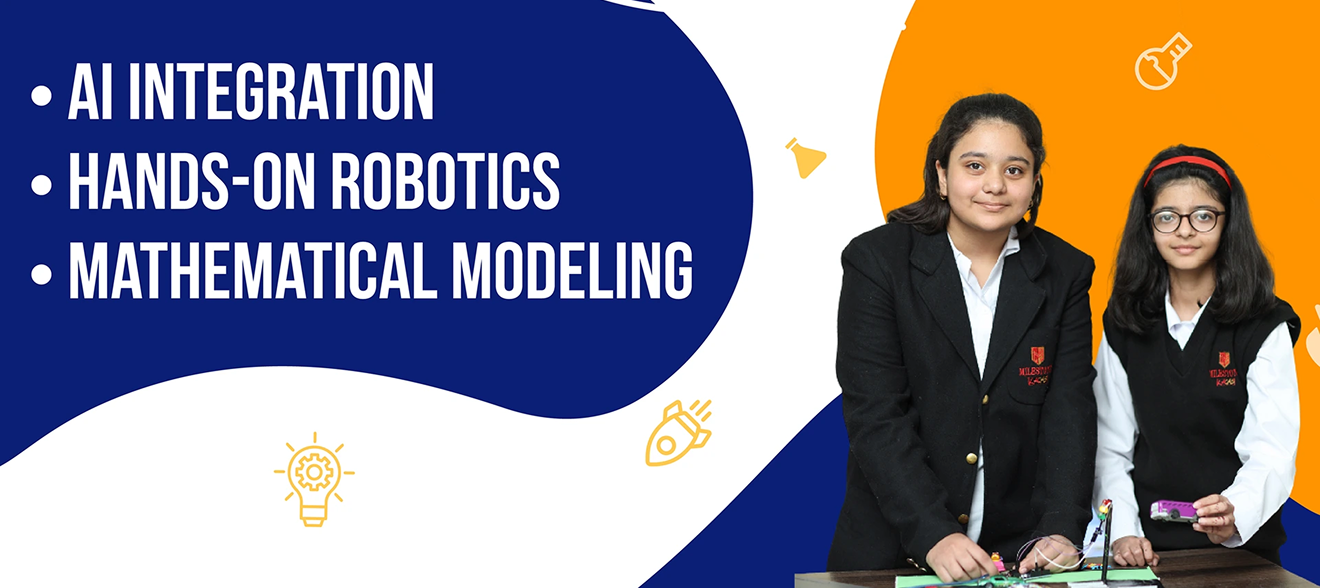
By utilizing Project-Based Learning, TMS allows students to see the connection between a mathematical formula and an engineering challenge. For instance, instead of just studying the physics of force and motion, students might be tasked with building a bridge or a functional robot. This hands-on learning ensures that abstract concepts become tangible realities.
Redefining the Classroom Experience
At The Milestone School, the learning environment is designed to support the principles of Project Based Learning. Teachers at TMS are specialists in their fields who understand that their role is to guide rather than dictate.
By providing a safe and supportive atmosphere, TMS encourages students to take intellectual risks. This culture of inquiry ensures that students graduate not just with grades, but with a portfolio of work that demonstrates their ability to think, create, and lead.
Conclusion: Preparing for a Future of Innovation
As we look toward the future, it is clear that Project Based Learning provides a powerful pathway for skill development. It moves education away from the industrial model of learning and toward an approach that values creativity, critical thinking, and real world application.
The Milestone School (TMS) represents this progressive approach in Pakistan. With a strong STEM focused curriculum and a commitment to student centered, hands-on learning, TMS ensures that its students are not just observers of the future, but the innovators shaping it.
To learn about the admissions to The Milestone School, parents visit our official website or schedule a campus visit to experience the learning environment and classrooms firsthand.
FAQs
What is Project-Based Learning?
Project-Based Learning (PBL) is an instructional strategy where students gain knowledge and skills by investigating and responding to complex questions, problems, or challenges over an extended period.
Why does TMS advocate for PBL?
At TMS, we believe in transforming classroom education from passive to active, where students participate, investigate, create and reflect. PBL enhances student engagement, fostering a deeper understanding of academic topics while developing practical skills.
How can I apply to TMS?
Admissions are typically open at various times of the year. Please keep an eye on our website or contact our office for more information.
When are admissions open?
The school calendar varies each year, and we encourage parents to reach out to us or visit our website for the most recent updates.
How can I learn more about PBL programs at TMS?
Visit our campus or contact us through our website to explore our project-based learning programs further.
Why is hands-on learning important?
Hands-on learning encourages active student participation, leading to better retention and understanding of concepts. It also aids in the development of practical skills such as problem solving and creativity.